
The Quad grouping has expanded cooperation in critical minerals and energy, while unveiling new measures to boost maritime surveillance and port infrastructure across the Indo-Pacific. This move comes against the backdrop of China's growing military posturing in the region, with ministers reiterating strong opposition to destabilising actions and expressing serious concerns over militarisation of disputed features.

In response to the Quad ministers' joint statement, China on Tuesday said it opposes the creation of exclusive 'small cliques' and 'bloc confrontation'.

US Secretary of State Marco Rubio has said that the US is ready to sell as much energy as India is willing to buy. He described India as a 'great partner' ahead of his visit to New Delhi.

US Secretary of State Marco Rubio arrived in Kolkata for a four-day diplomatic tour to India, marking the first visit by a US secretary of state to the city in 14 years. His itinerary includes meetings with Indian officials, energy talks, and a Quad Foreign Ministers Meeting.

Ambassadors of the Quad nations, consisting of the United States, India, Australia and Japan, held a rare publicised meeting in Beijing.

'The flip side of this is that he won't hesitate to call out India if he thinks its policies are hurting US economic interests or border US foreign policy goals.'

The Japanese PM's visit to Assam comes amid festering uneasiness in Tokyo about Beijing's assertiveness in the Indo-Pacific region.

Prime Minister Narendra Modi and US Secretary of State Marco Rubio discussed various aspects of India-US bilateral ties, focusing on defence, trade, energy, and technology. Rubio extended an invitation from President Donald Trump for PM Modi to visit the US.

US Secretary of State Marco Rubio met with Pakistan's Foreign Minister Ishaq Dar amid American demand that countries mediating the peace talks with Iran join the Abraham Accords and establish diplomatic and economic ties with Israel.

A readout by the US said the agreement marked a milestone in the strategic partnership between the two nations to ensure that the foundational elements required for advanced technology and energy are available within trusted networks.
David Perdue said in a post on X that the US-India relationship delivers real results through close cooperation in diverse areas, including defence, energy and through Quad engagement.

The US-China rapprochement, however tenuous, is not without implications for India. Both China and Pakistan have become closer to the US, notes Ambassador T P Sreenivasan.

US President Donald Trump's call to Prime Minister Narendra Modi signals a concerted effort to reset strained Washington-New Delhi ties, with a focus on 'big-ticket' energy and trade deals, including increased Indian imports of US LNG and LPG, and potential cooperation on small modular reactors.

In the midst of rising global concern over China's military expansionism, India and three other member nations of the Quad on Thursday vowed to uphold a rules-based international order underpinned by respect for territorial integrity and sovereignty, freedom of navigation and peaceful resolution of disputes.
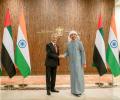
Frankly, was it really necessary in the middle of a fratricidal war for External Affairs Minister S Jaishankar to travel to Abu Dhabi for a one-on-one with the sheikh on April 12?Or, for National Security Advisor Ajit Doval to follow up on April 26? Or, for PM Narendra Modi to follow through today? There are no easy answers, notes Ambassador M K Bhadrakumar.
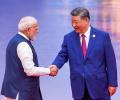
For India, China's Indian Ocean power projection, maritime domain awareness, dual-use ports, underwater surveillance, antisubmarinewarfare, naval exercises with Pakistan, pose considerable pressure, depleted India's strategic depth and marginalises Indian role, points out Srikanth Kondapalli.

In his opening remarks at a ministerial meeting in Tokyo of the Quadrilateral coalition, also known as 'Quad', External Affairs Minister S Jaishankar said India remained committed to a rules-based world order, respect for territorial integrity and sovereignty, and peaceful resolution of disputes.
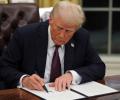
Dr Jaishankar is expected to discuss the dates for the fifth Quad leaders' summit in India later this year.

The coast guards of India, Japan, the US and Australia have launched the first-ever "Quad-at-sea" mission to boost operational coordination and interoperability in the Indo-Pacific.
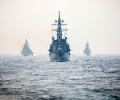
Aircraft carriers of India, the United States, Japan and Australia are set to take part in the second phase of Exercise Malabar that is scheduled to take place from November 17 to 20 in the Indian Ocean region, the Navy said on Monday.

External Affairs Minister S Jaishankar discussed the West Asia conflict's impact on the global economy, particularly energy security, with US Secretary of State Marco Rubio. He also engaged with GCC ambassadors and his Sri Lankan and German counterparts on the same issue.
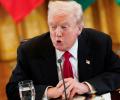
United States President Donald Trump said he could travel to India next year, emphasising that Indian Prime Minister Narendra Modi 'wants' him to visit while calling him a 'great man' and a friend.
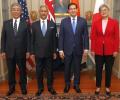
The Quad grouping has called for bringing the perpetrators, organisers and financiers of the Pahalgam terror attack to justice without any delay and urged UN member nations to extend cooperation for it.

The navies of India, the US, Japan and Australia on Tuesday held a series of complex manoeuvres in the Bay of Bengal, kick-starting the four-day-long first phase of the Malabar naval exercise, seen as a prelude to future military cooperation among the member nations of the Quad or Quadrilateral Coalition.

The high-voltage Malabar exercise featuring the navies of all four Quad countries -- India, the US, Australia and Japan -- began on Thursday off the coast of Guam against the backdrop of a resolve by the four nations to solidify cooperation for a free and open Indo-Pacific in view of China's rouge behaviour in the region.
Increasing cooperation in critical minerals will top Prime Minister Modi's agenda during his discussions with leaders of Ghana, Argentinia, Brazil and Namibia.
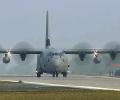
If Lockheed Martin gets the opportunity, then it will set up a mega hub in India to produce the "iconic" aircraft and it will be the first such global facility outside of the US, top officials of the company told PTI.

'We condemn recent illicit missile launches in the region that violate UN Security Council resolutions. We express serious concern over recent dangerous and aggressive actions in the maritime domain. We seek a region where no country dominates and no country is dominated one where all countries are free from coercion, and can exercise their agency to determine their futures,' the declaration said.

Australia beat India by six wickets in the first Women's ODI in Brisbane, with fifties from Alyssa Healy and Beth Mooney, and Ashleigh Gardners 3-33 sealing a 1-0 series lead despite Mandhana and Harmanpreet's efforts.
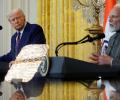
India and the US have entered a new phase in their relationship, marked by greater parity, point out Harsh V Pant and Vivek Mishra.

'TTP has vowed to take revenge for the attacks that Pakistan is carrying out against Afghanistan.' 'To diminish this threat, Pakistan is hitting Afghanistan hard.'

Pakistan launched a retaliatory operation, 'Ghazab lil Haq,' against the Afghan Taliban following alleged border attacks, resulting in reported casualties and destruction of Taliban infrastructure.
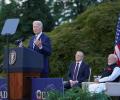
United States President Joe Biden was caught on a hot mic telling leaders of the Quad nations that China was testing them, thus reflecting upon the American seriousness of the emerging Chinese threat.
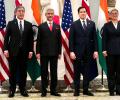
Soon after he was sworn in by Vice President J D Vance, US Secretary of State Marco Rubio hosted External Affairs Minister S Jaishankar, Penny Wong from Australia and Japan's Iwaya Takeshi for his first multilateral meeting as the top American diplomat.

Ever since the Quad started taking shape in 2007, China has been saying that the four-member grouping will be bound to fail. But much to the chagrin of Beijing, it picked up pace in the recent years emerging as a premier strategic group especially challenging China's assertiveness in the disputed South China Sea.

US President Donald Trump greeted India on its 77th Republic Day, highlighting the historic bond between the two democracies amid ongoing trade tensions.
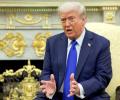
The US Representative criticised the administration's new USD 100,000 fee on H-1B visas, observing that Indians hold 70 per cent of these visas and saying the change directly harms workers who have long supported US innovation across technology, science and medicine.
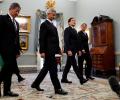
In a move sending a strong signal to China, foreign ministers from Quad countries -- India, Australia, Japan and the United States -- in a joint statement on Tuesday strongly opposed any unilateral actions that seek to change the status quo by force or coercion.

In the Indo-Pacific's new era -- where perception shapes reality faster than treaties -- the real entrapment is not of China or the United States. It is the test Japan has set for itself -- and whether partners like India, acting as balancers rather than accelerants, can help ensure that the story ends in stability, points out Varun Arya.

The Quad also vowed to work towards a free, open and prosperous Indo-Pacific, a region that has seen increasing Chinese military muscle-flexing in the last few years.
